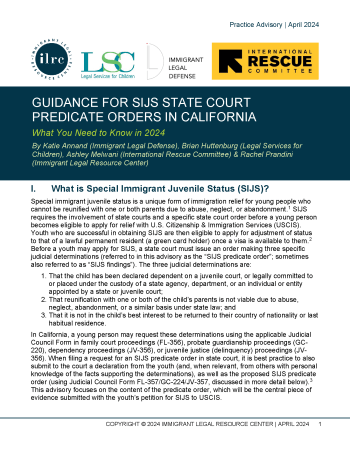
This updated guidance, written with our partners Immigrant Legal Defense (ILD), International Rescue Committee (IRC), and Legal Services for Children (LSC), includes recommendations for what information to include in state court predicate orders for special immigrant juvenile status (SIJS) in California. It incorporates guidance from the 2022 SIJS regulations as well as the USCIS Policy Manual, and includes helpful citations to California law. It also includes sample predicate orders from family, probate, dependency, and delinquency courts.
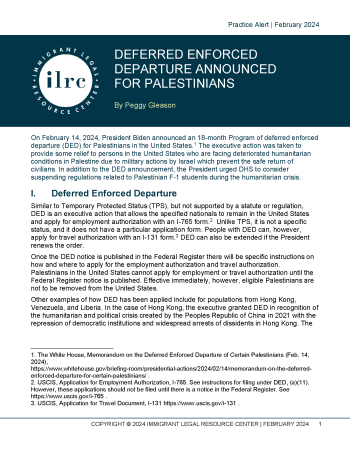
On February 14, 2024, President Biden announced an 18-month Program of deferred enforced departure (DED) for Palestinians in the United States. This alert describes the content of the executive order. Eligible persons may apply for employment and travel authorization under the program when a notice is published in the Federal Register.
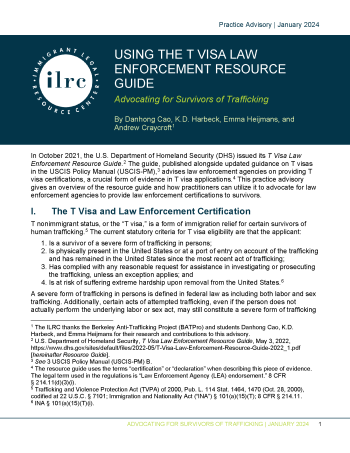
In October 2021, the U.S. Department of Homeland Security (DHS) issued its T Visa Law Enforcement Resource Guide. The guide, published alongside updated guidance on T visas in the USCIS Policy Manual (USCIS-PM), advises law enforcement agencies on providing T visa certifications, a crucial form of evidence in T visa applications. This practice advisory gives an overview of the resource guide and how practitioners can utilize it to advocate for law enforcement agencies to provide law enforcement certifications to survivors.
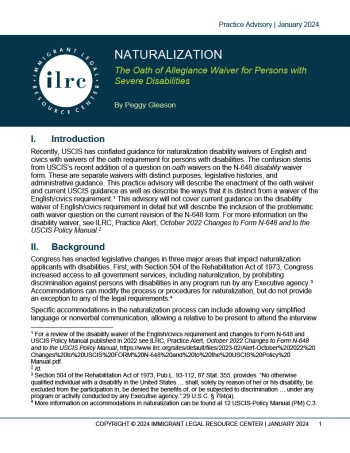
Recently, USCIS has conflated guidance for naturalization disability waivers of English and civics with waivers of the oath requirement for persons with disabilities. The confusion stems from USCIS’s addition of a question on oath waivers on the N-648 disability waiver form. These are separate waivers with distinct purposes, legislative histories, and administrative guidance.
This practice advisory will describe the enactment of the oath waiver and current USCIS guidance as well as describe the ways that it is distinct from a waiver of the English/civics requirement.
This practice advisory will describe the enactment of the oath waiver and current USCIS guidance as well as describe the ways that it is distinct from a waiver of the English/civics requirement.
Law enforcement agencies in California have been responding to requests for U visa certifications for many years to allow immigrant survivors of crime and their family members to apply for U nonimmigrant status. However, until 2016 there was no statewide standard or protocol for certifications. Several bills have passed in the meantime to further streamline the process. Most recently, AB 1261 was signed into law in October 2023 and went into effect on 01/01/2024. The Immigrant Legal Resource Center and the Los Angeles Center for Law and Justice wrote this advisory to summarize California state laws on U visa certifications, including the newest provisions.

This practice alert provides an overview of updated USCIS policy on the Child Status Protection Act (CSPA), which affects noncitizens hoping to immigrate through adjustment of status as the “child” of a lawful permanent resident or other derivative “child” beneficiary and who might rely upon CSPA to remain classified as a “child” even if their biological age is 21 or older. On August 8, 2025, USCIS announced that it was reversing a 2023 policy relating to the CSPA. This alert describes the 2023 guidance, current guidance, and CSPA provisions impacted by this change.